
Solar water pumps · Lorentz
Water where there is sun but no mains.
A solar pump runs straight off its array — no batteries, no fuel deliveries, no standing charge. We size the system around your head, flow rate and daily volume, and we'd rather tell you it won't work than sell you an undersized set.
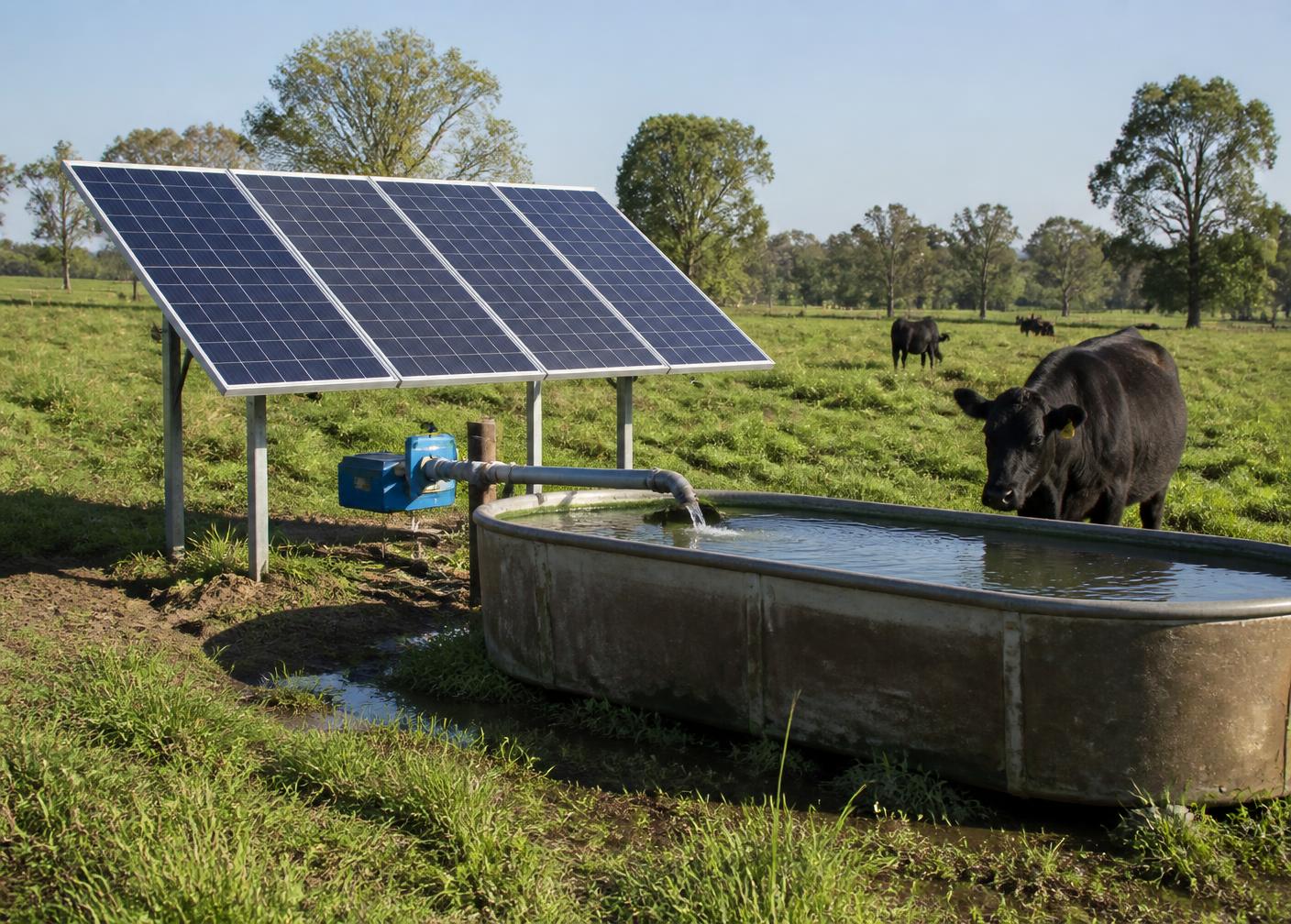
Where they're used
Four jobs these systems do well
Livestock troughs
Move water from a borehole or stream to fields with no supply. Float-switch control fills the header tank and stops; no daily attendance.
Irrigation
Field-scale abstraction for horticulture and soft fruit. Output follows solar irradiance, which usually tracks when the crop needs water.
Borehole abstraction
Submersible sets for deep boreholes where a mains connection would cost more than the whole pumping system.
Remote buildings & reservoirs
Filling storage tanks and reservoirs at sites with no three-phase supply, replacing diesel pump runs and the fuel haulage that goes with them.
Technical summary
Typical specification range
Final selection comes from a pump curve matched to your measured head and required daily volume — these are the envelopes we work within.
- System type
- Lorentz PS2 and PSk2 — helical rotor, centrifugal and surface booster
- Array size
- Typically 0.3–4.0 kWp, ground-mounted or pole-mounted
- Total dynamic head
- Up to approximately 450 m depending on pump end selection
- Daily volume
- From roughly 3 m³/day for a trough to 200 m³+/day for irrigation
- Control
- Integrated MPPT controller, dry-run protection, remote monitoring via PumpScanner
- Power source
- Solar direct — no batteries required. Optional mains or generator fallback
- Well depth
- Submersible sets for boreholes; surface sets for streams, ponds and reservoirs
- Materials
- Stainless steel wetted parts; galvanised or A2 stainless frames
What we need from you
Five numbers and we can size it
- 01
Water source and depth to water level
- 02
Vertical lift from source to discharge
- 03
Pipe run length and diameter
- 04
Litres needed per day, peak month
- 05
Whether storage or a tank already exists
Don't have the figures? Most farms don't. Tell us the site and what it's for and we'll work them out on a visit — abstraction licensing permitting, which we'll flag if it applies.
Send us the site details and we'll size it properly.
Pump enquiries go straight to the agricultural team, not the domestic sales line.